English occupation of the Île de Ré
The Three MusketeersThe English occupation of the Île de Ré is the decisive first movement of the English expedition against the French positions guarding La Rochelle. It gives Buckingham an immediate territorial advantage, isolates the French defenders in St. Martin and Fort La Pree, and forces Cardinal Richelieu to turn a contested regional struggle into a concentrated campaign. The episode also reveals how military ambition, international Protestant alliances, French state power, and the private rivalry surrounding Anne of Austria converge in one coastal operation.
Political and International Background
The occupation takes place against the larger French attempt to destroy La Rochelle, the last major stronghold left to the Huguenots after the other Calvinist cities had been surrendered to the crown. The city had become a focus for civil revolt, foreign intervention, and religious conflict. Spaniards, Englishmen, Italian malcontents, adventurers, and soldiers of fortune from many confessions gathered beneath the Protestant standard, creating a network whose branches extended across Europe. La Rochelle’s port also remained the last harbor in France open to English access, so closing it would serve both the religious policy of the French crown and its strategic hostility toward England.
The English expedition was therefore not merely an attempt to relieve a besieged Protestant city. Buckingham wished to defend England’s honor, but he also pursued a private vengeance and sought to enter France as a conqueror rather than as an ambassador. The broader war consequently carried an intimate and ironic stake: the military contest between two kingdoms was entangled with the desire of two powerful men for a favorable look from Anne of Austria. The occupation of the Île de Ré materializes that collision between public policy and private passion.
The Landing and Seizure of the Island
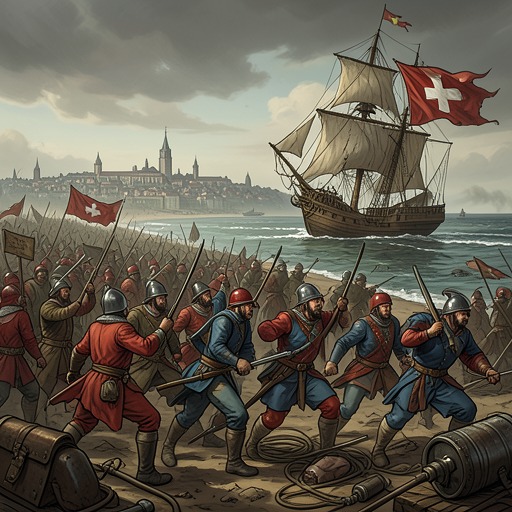
Buckingham gained the first advantage by appearing unexpectedly before the Île de Ré with ninety vessels and nearly twenty thousand men. The scale of the force made the landing an operation of invasion rather than a minor raid. He surprised the Comte de Toiras, who commanded the island for the French crown, and after a bloody conflict succeeded in establishing English control of the island. The action immediately placed the English in possession of a forward position from which they could threaten the French defenses and support the Protestant cause at La Rochelle.
The French defense did not collapse entirely. The Comte de Toiras withdrew with his garrison into the citadel of St. Martin, while one hundred men were sent into the smaller Fort La Pree. The occupation thus produced a divided military situation: the English controlled the island and its approaches, but the principal French strongpoints remained in hostile hands. Buckingham’s success was substantial, yet it still required the reduction of the citadel and the fort before the island could serve fully as the base for relief operations.
The landing also carried a human cost beyond the principal commanders. The Baron de Chantal died in the fighting, leaving an eighteen-month-old orphan girl who would later become Mme. de Sevigne. That detail places the spectacular movement of fleets and armies beside the private consequences of battle: a territorial gain for England becomes, for one family, an irreversible loss.
French Mobilization and the War Camp
The English occupation hastened Cardinal Richelieu’s preparations. Until Louis XIII and Richelieu could personally assume command of the siege of La Rochelle, Monsieur was sent to direct the first operations, and all available troops were ordered toward the theater of war. d'Artagnan formed part of this vanguard. His presence links the strategic consequences of the island operation to the novel’s personal adventure narrative: the young soldier’s ambitions and dangers unfold inside a campaign whose scale is determined by Buckingham’s landing.
The royal advance was delayed when Louis XIII fell ill with fever after rising from his Bed of Justice on June 28. Because the Musketeers halted whenever the king halted, d'Artagnan, still serving in the Guards and not yet admitted to the Musketeers, became separated from Athos, Porthos, and Aramis. He nevertheless reached the camp before La Rochelle on September 10, 1627. By then Buckingham’s English forces still held the Île de Ré and continued, unsuccessfully, to besiege the citadel of St. Martin and Fort La Pree, while hostilities had begun near La Rochelle itself around a fort constructed by the Duc d'Angouleme.
The French response was eventually organized as a coordinated effort to drive the English from the island. After the commanders established their separate quarters, the French began that operation directly. The English camp suffered from poor provisions, with soldiers living on salt meat and bad biscuit and many men becoming invalids. Rough seas destroyed small vessels along the coast, and the shoreline filled with wrecks. These logistical pressures meant that Buckingham’s occupation was endangered not only by French arms but also by hunger, illness, and the sea. Even without an immediate assault, the expedition risked becoming unsustainable.
Defeat of the English Expedition
When information arrived that the English were preparing a fresh assault, Louis XIII judged that delay was dangerous and ordered a decisive action. The French expedition succeeded. The English were repulsed step by step, beaten in successive encounters, and defeated while attempting to pass the Isle of Loie. They were forced to re-embark, leaving two thousand men on the field, including five colonels, three lieutenant colonels, two hundred and fifty captains, and twenty gentlemen of rank. The French also captured four pieces of cannon and sixty flags, which were carried to Paris by Claude de St. Simon and displayed with ceremony in the arches of Notre Dame.
The result ended the English occupation as an effective military challenge to the French siege. Te Deums were sung in the camp and afterward throughout France, while Richelieu was left free, at least temporarily, to continue the siege of La Rochelle without fearing immediate English intervention. The island episode therefore follows a clear strategic arc: surprise landing and territorial mastery, prolonged failure to eliminate the French strongholds, mounting logistical weakness, and eventual evacuation under military pressure.
Consequences for the Wider Conflict
The French victory did not remove the international danger. An envoy of Buckingham named Montague was captured, and evidence emerged of a league joining the German Empire, Spain, England, and Lorraine against France. Papers found in Buckingham’s abandoned lodging confirmed the alliance and, according to Richelieu’s account, seriously compromised Mme. de Chevreuse and consequently the queen. The failed occupation thus generated a second crisis, this time in the realm of intelligence, diplomatic suspicion, and court politics.
The island operation also shaped the later movement of the plot across the Channel. England appears not as a distant foreign setting but as a naval power capable of assembling fleets, launching armies, sustaining a Protestant network, and threatening French royal policy from a coastal base. Buckingham’s preparations later become the object of Milady’s mission, while a letter from Anne of Austria urges him to abandon the armaments being prepared against France. That appeal identifies the concealed emotional force behind the war even as the military events demonstrate how little private feeling can contain once ships, soldiers, ports, religion, and state power have been mobilized.
In this sense, the occupation of the Île de Ré is both a military state and a narrative hinge. It turns Buckingham’s personal resolve into an international expedition, forces Richelieu to accelerate the French campaign, brings d'Artagnan into the royal army’s movement toward La Rochelle, and supplies the evidence and political consequences that continue after the English have been driven from the island. Its significance lies not only in who held the island, but in how quickly a landing on its shores expanded into a crisis involving France, England, La Rochelle, the queen, and the competing instruments of royal and cardinal power.